Custom Kippah Order Mistakes: What Goes Wrong on a First Order and How to Avoid It
Most first orders of custom kippahs go wrong in the same few places: a material picked for looks instead of the event, a guest count with no spares, a Hebrew name or date nobody double-checked and a mockup approved in a hurry. Get Custom Kippahs walks through each mistake below so your kippahs arrive right the first time.

- Choose the kippah material for the setting, not only the color swatch.
- Order spares above your guest count; a reorder is a new production run.
- Have a Hebrew reader check every name and date on the mockup.
- Get Custom Kippahs sends a free mockup within 24 hours and starts at 12 pieces.
- Standard turnaround is about 2 weeks after you approve the design.
What is the most common mistake on a first custom kippah order?
The most common mistake on a first custom kippah order is choosing the material from a color swatch instead of from the way the kippahs will actually be used. A glossy satin kippah looks beautiful in a photo, but it is built for a single wedding or bar mitzvah, not for a school where boys wear the same kippah every day.
Start with the setting, then pick the material. Ask who will wear the kippahs, for how long and how often. A guest who wears a kippah for an afternoon ceremony has very different needs from a yeshiva student or a regular at a weekday minyan.
| Setting | Material that usually fits | Common mismatch |
|---|---|---|
| Wedding or bar mitzvah guests | Satin, suede or raw silk | Knit, which can look too casual next to formal wear |
| Daily school wear | Knit or crochet | Satin, which creases and slips with daily use |
| Synagogue loaner supply | Suede or velvet | Linen, which shows wear quickly in a shared bin |
| Keepsake or gift | Velvet or leather | A thin material that does not feel like a gift |
If you are still unsure, the satin vs. suede vs. knit comparison lays out the trade-offs side by side.
Why do so many people run short of kippahs at the event?
People run short of custom kippahs because they order exactly the RSVP count and forget everyone who is not on the guest list. Musicians, photographers, the caterer’s staff who step into the room during the ceremony, last-minute plus-ones and guests who take a kippah home as a keepsake all draw from the same box.
Short counts are hard to fix late, because a reorder of custom kippahs is a new production run with its own mockup approval and its own turnaround of about 2 weeks. A small cushion on the first order is far easier than a rush on the second.
- Count every man expected in the sanctuary or under the chuppah, not only invited guests.
- Add spares for keepsakes, vendors and walk-ins.
- Ask whether women at a Reform or Conservative event may also want a kippah.
- Keep leftover kippahs for a future simcha or for your synagogue’s loaner bin.
For a full walk-through on counts, see the guide on how many kippahs to order for a wedding.
What imprint mistakes show up on custom kippahs?
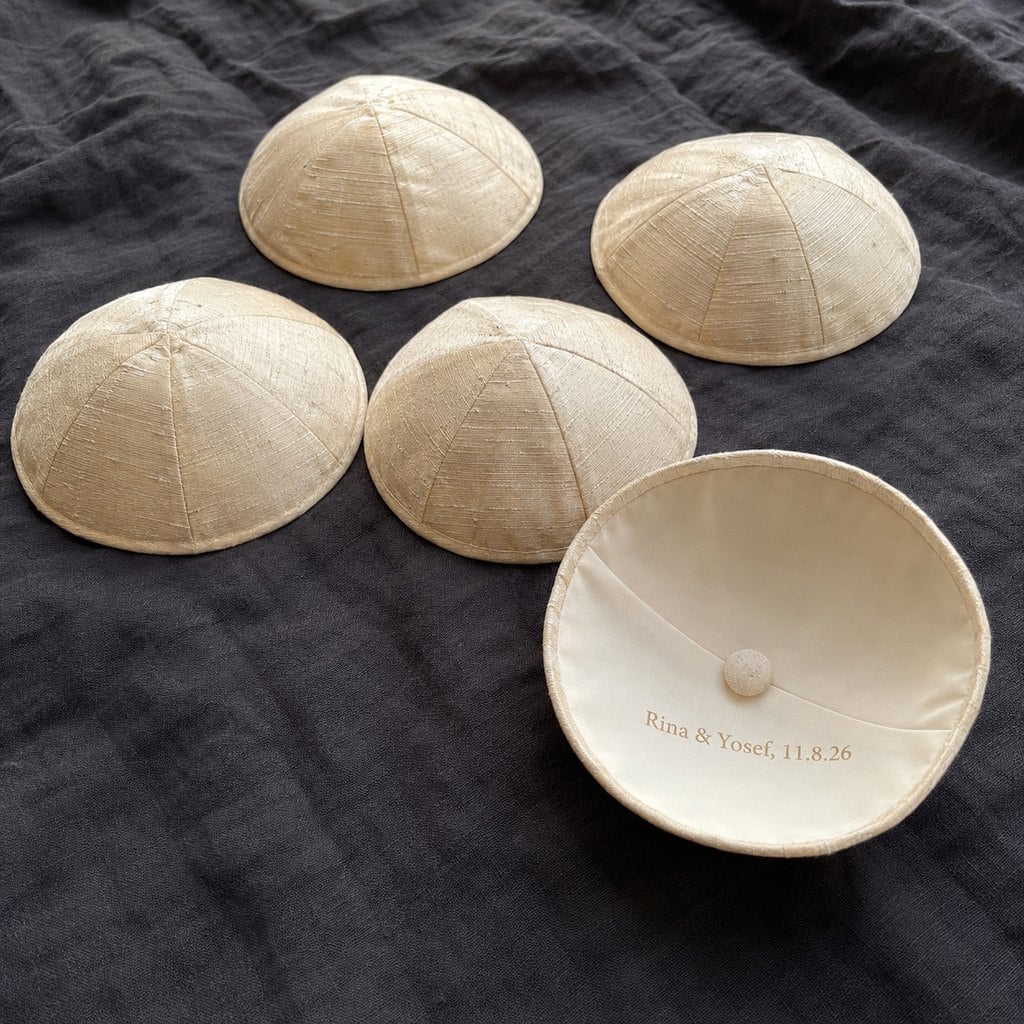
The imprint mistakes that show up most on custom kippahs are a wrong Hebrew date, a misspelled name, artwork too detailed for the space inside the crown and a foil color that disappears into the lining. Each one is easy to catch on the mockup and almost impossible to fix after production.
The Hebrew date and names
Hebrew dates shift relative to the secular calendar, and an evening event can fall on the next Hebrew day. Confirm the date with your rabbi or a Hebrew calendar, and ask a fluent Hebrew reader to check spelling, vowel choices and letter order on the proof.
Too much artwork
The imprint area inside a kippah is small and curved. A full monogram, both families’ names, the date and a verse rarely fit legibly together. Choose the two or three elements that matter most.
Low-contrast foil
Gold foil on a cream lining or silver on light gray can be hard to read in a dim sanctuary. Pick a foil color that clearly contrasts with the lining. The guide on what to imprint inside a kippah covers wording ideas that fit the space.
How do people get the timing wrong on custom kippahs?
People get the timing wrong on custom kippahs by counting only the production time and ignoring everything that happens before it: choosing a material, collecting names, waiting for a family member to approve the wording and revising the mockup. Those decisions often take longer than the production run itself.
Get Custom Kippahs sends a free mockup within 24 hours of your request, and standard turnaround is about 2 weeks after you approve the design, with faster delivery available through express shipping. The calendar risk sits mostly on your side of the approval.
- Decide the material and color before you request the quote.
- Gather every name, date and logo file in one message.
- Name a single person who has final sign-off on the mockup.
- Approve the design with time to spare before the event, not the week of it.
Families planning around holidays should also check that the delivery window does not land on Shabbat or Yom Tov when no one can receive a package.
Should I approve a kippah mockup quickly or take my time?
Take your time on a custom kippah mockup, because the mockup is the last point where any change is free. Get Custom Kippahs offers unlimited free revisions, and you pay nothing until you approve the design, so a slow, careful review costs you nothing while a rushed approval can cost the whole run.
A good proof review looks at more than the artwork. Check the kippah color against the lining color, the foil color, the placement of the imprint, the quantity and the size breakdown if you are ordering for children and adults together. Read every line of text out loud, letter by letter, including the English spelling of names.
- Print or enlarge the mockup and read it away from your phone.
- Ask someone who did not write the wording to proofread it.
- Confirm the quantity and material match what you meant to order.
- Reply with every change in a single message to avoid version confusion.
Is it a mistake to mix materials or colors in one kippah order?
Mixing materials or colors in one custom kippah order is not a mistake on its own, but it becomes one when the split is guessed instead of planned. A common example is ordering half navy and half white kippahs for a wedding without knowing how many guests will choose each color, then running out of the popular one early.
A mixed order works well when each group is defined in advance: suede kippahs for the family and satin for guests, knit kippahs for students and velvet for rebbeim, or a separate color for the groom’s side and the bride’s side. Each variation should be its own clear line on the quote, with its own count.
If you want different names or different imprints inside each kippah, send the list as a clean spreadsheet with one name per row. Free-typed lists in an email are where most personalization errors begin. Bar and bat mitzvah families can find more on splitting counts in the bar mitzvah kippah guide.
What should a first-time buyer send to avoid a back-and-forth?
A first-time buyer of custom kippahs avoids a long back-and-forth by sending everything in the first request: the event type and date, the quantity, the material and color, the imprint wording and any logo or monogram file. A complete request lets Get Custom Kippahs return an accurate mockup within 24 hours instead of a list of questions.
- Event and date, plus the date you need the kippahs in hand.
- Quantity, starting at the minimum of 12.
- Material and color, or the setting if you want a recommendation.
- Exact wording in English and Hebrew, with names spelled as you want them printed.
- Logo or crest files in the best format you have.
- The shipping address and who will receive the box.
The step-by-step ordering checklist covers each item in more detail, and how it works explains the proof and approval stages. When you are ready, request a custom quote.
Frequently asked questions
Can I fix a spelling error on custom kippahs after they are made?
Custom kippahs cannot be corrected once the imprint is stamped, because foil and print bond permanently to the lining. A spelling error after production usually means reordering the affected pieces. That is why Get Custom Kippahs sends a free mockup first and lets you revise it as often as you need before approving, so errors are caught while changes still cost nothing.
Is ordering the exact RSVP count of kippahs a bad idea?
Kippahs ordered at the exact RSVP count often run short, because vendors, musicians, walk-in guests and people who keep a kippah as a souvenir all take from the same supply. A modest cushion of spares is easier than a reorder, which requires a fresh production run. Leftover kippahs can serve a synagogue loaner bin or a later family simcha.
Why does gold foil sometimes look faint inside a kippah?
Gold foil inside a kippah looks faint when the lining color is too close to the foil, such as gold on cream or ivory. Foil also reads lighter in dim sanctuary lighting. Choose a lining and foil pair with strong contrast, like gold on navy or silver on black, and review the pairing on the mockup before you approve the order.
Should children and adults get the same size kippah at a bar mitzvah?
Kippahs for a bar mitzvah often need two sizes, because a kippah sized for adults can slide off a young child's head during dancing. Note in your quote request how many children are expected, and Get Custom Kippahs can suggest a split. Getting the size breakdown right on the first order avoids a scramble the morning of the event.
How can a family avoid arguments over the kippah wording?
Kippah wording disagreements are best avoided by naming one person with final approval before the mockup arrives. Collect suggestions from both families first, agree on the names, date and any verse, then send a single final version. Get Custom Kippahs offers unlimited free revisions, but a clear decision-maker keeps the proof moving and the delivery date safe.
Is satin a poor choice for kippahs worn every day?
Satin kippahs are a poor fit for daily wear because the smooth surface slips on hair, creases with folding and shows wear quickly. Satin shines at single events like weddings. For students or daily minyan regulars, knit or crochet kippahs hold their shape better, grip more securely and tolerate being stuffed into a pocket or backpack.
What happens if I approve a kippah mockup with the wrong quantity?
Kippahs are produced in the quantity shown on the approved mockup and order, so an approved wrong number is the number that ships. Before approving, confirm the total and each color or size line individually. If you notice a quantity problem early, tell Get Custom Kippahs right away so it can be corrected before production begins.
Can I send a phone photo of our logo for kippah imprinting?
Kippah imprints can start from a phone photo, but blurred edges, glare and skewed angles usually make the result look soft. Send the original logo file whenever possible, or the clearest scan you have. Get Custom Kippahs reviews every file and shows the result on a free mockup within 24 hours, so you see how the logo will read before approving.
Is it risky to order custom kippahs the month of the event?
Custom kippahs ordered the month of the event are not automatically late, but the margin for revisions shrinks quickly. Standard turnaround is about 2 weeks after design approval, so slow decisions on wording or material eat the buffer. Get Custom Kippahs returns a mockup within 24 hours, and express shipping can help when the calendar is genuinely tight.
Why should a Hebrew speaker review the kippah proof?
Kippah proofs with Hebrew text should be read by a fluent Hebrew reader, because reversed letters, missing letters and wrong vowel choices are easy for non-readers to miss. Hebrew dates can also shift for evening events. Ask your rabbi or a knowledgeable family member to check the mockup from Get Custom Kippahs before you approve production.
Do I need separate quotes for different kippah materials?
Kippahs in different materials can usually go on one quote request, listed as separate lines with their own quantities, such as suede for family and satin for guests. Keep each line clear so nothing is merged by mistake. Include the setting for each group, and the mockup will show every material and imprint so you can review them together.
Should leftover kippahs from one event shape the next order?
Leftover kippahs from a past event are useful data for the next order. If many were left, your spare margin was generous; if you ran out, increase it. Note which colors and materials guests preferred. Synagogues and schools that reorder regularly can share those notes with Get Custom Kippahs to make the next quote faster and more accurate.
Get a free mockup for your kippahs
Send your logo or idea and the quantity you have in mind. Get Custom Kippahs returns a free mockup within 24 hours, you approve the design before anything is produced, and standard turnaround is about two weeks with faster options available. Get a custom quote.