Custom Kippah Artwork: How to Prepare Your Logo, Monogram and Lettering
Custom kippah artwork works best when it is simple, single-color and sent as a clean vector or high-resolution file. Get Custom Kippahs lays your logo, monogram or names and date onto the lining or crown, matches your colors and returns a free mockup within 24 hours, so you can fix spelling, spacing and contrast before a single kippah is made.
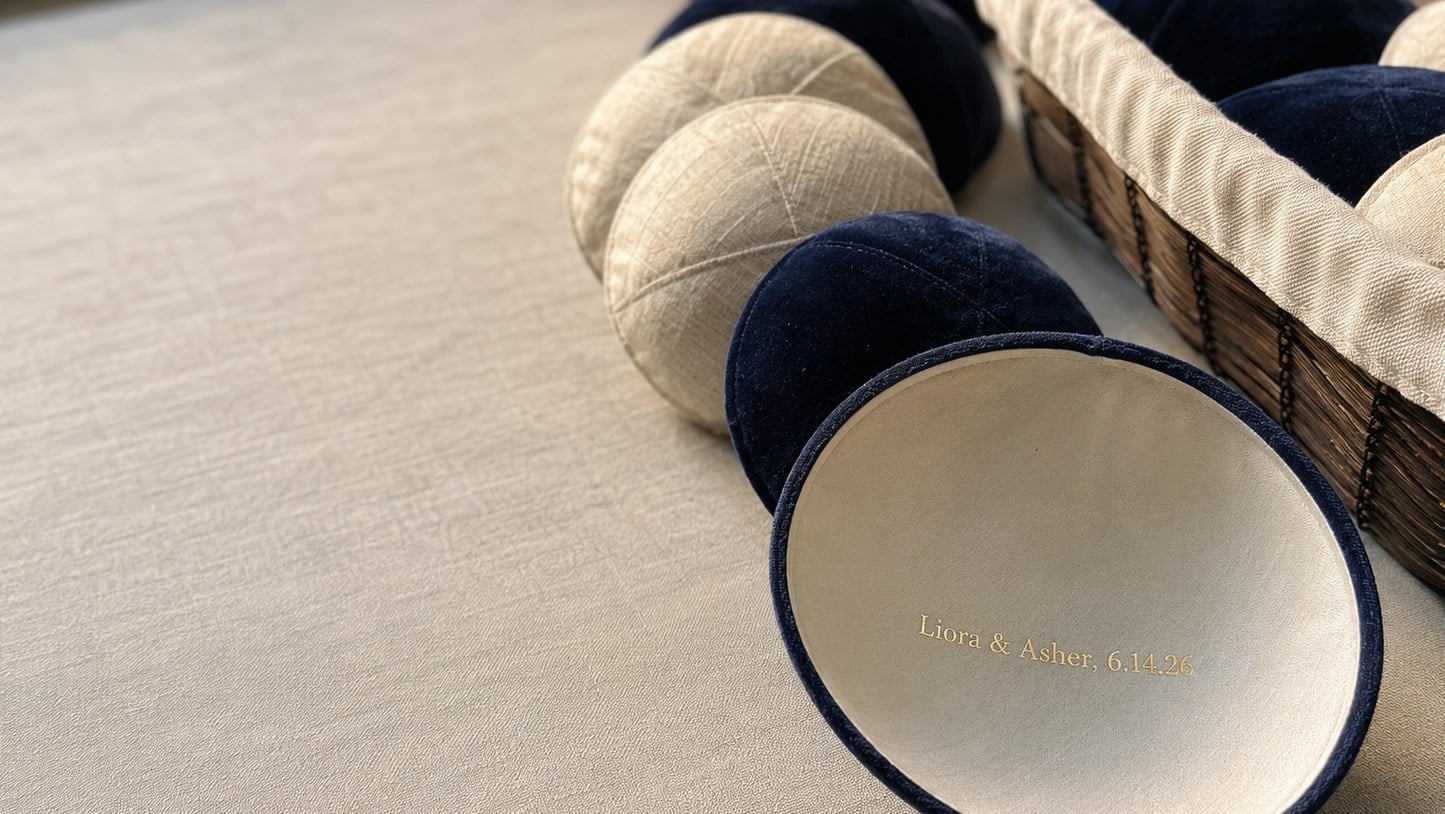
- Vector files (AI, EPS, SVG or vector PDF) give the sharpest foil and print imprints on kippahs.
- Foil stamping is a single-color method, so bold, simple artwork reads best inside a kippah.
- Get Custom Kippahs returns a free mockup within 24 hours with unlimited free revisions.
- Nothing goes to production until you approve the proof; minimum order is 12 kippahs.
- Standard turnaround is about 2 weeks after approval, with faster options via express shipping.
What kind of artwork file do custom kippahs need?
Custom kippahs imprint most cleanly from vector artwork: an AI, EPS, SVG or vector PDF file where every letter and shape is a mathematical outline rather than a grid of pixels. Vector art scales down to the small imprint area inside a kippah without blurring, which matters because a kippah lining is far smaller than a letterhead or a banner.
If you do not have vector files, a high-resolution PNG or JPG is the next best option. Ask whoever designed your logo, wedding monogram or synagogue seal for the original file rather than saving an image from a website or a phone screenshot. Web images are built for screens and usually lose detail once they are reduced and stamped into fabric.
For a simple names-and-date imprint you do not need any file at all. Type the exact wording, the spelling you want and whether you prefer Hebrew, English or both, and the Get Custom Kippahs team sets the lettering for you on the mockup.
- Best: AI, EPS, SVG or vector PDF with fonts converted to outlines.
- Workable: a large, sharp PNG with a transparent background.
- Avoid: screenshots, social media images and photos of printed invitations.
How should a logo be simplified to fit inside a kippah?
A logo going inside a kippah should be reduced to its strongest, simplest version: one color, no gradients, no drop shadows and no hairline details. Foil stamping and lining prints reproduce solid shapes beautifully, but fine lines fill in and soft color blends disappear when the artwork shrinks to kippah size.
Many organizations already own a simplified mark, often called a one-color, stamp or favicon version of the logo. That version is usually the right choice for corporate and community kippahs. If your full logo includes a long tagline, keep the symbol and the name and drop the tagline; a short line of text is easier to read when someone flips the kippah over after an event.
Think about where the eye lands. The lining of a satin or suede kippah is round, so centered, compact artwork looks intentional, while a wide horizontal wordmark can feel cramped near the edges. When you request a quote, mention whether the artwork is a horizontal or stacked version, and the mockup will show how each one sits on the curve.
- Remove gradients, shadows and textures.
- Keep the symbol plus the name, drop small taglines.
- Choose a stacked or square layout for round linings.
Which imprint method suits my artwork: foil stamping or printing?
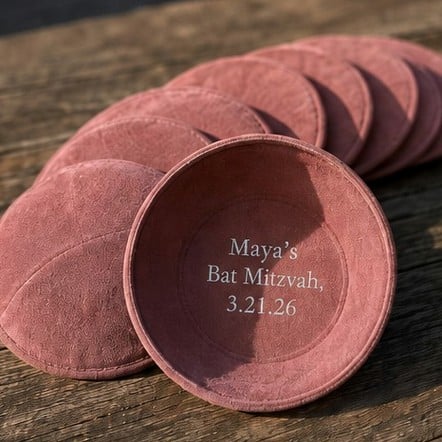
Foil stamping suits bold, single-color artwork such as names, dates, monograms and simple logos, and it gives custom kippahs that bright metallic finish guests associate with a simcha favor. Printing suits artwork that needs a specific brand color or slightly more detail. The right method depends on your artwork, the kippah material and the look you want.
| Artwork type | Foil imprint | Printed imprint |
|---|---|---|
| Names and date | Excellent, classic favor look | Good, matches event colors |
| Hebrew lettering | Excellent with a clear, bold font | Good with a clear, bold font |
| Simple one-color logo | Excellent, crisp metallic finish | Excellent, exact brand color |
| Fine detail or thin strokes | Simplify first | Better, still simplify tiny text |
| Gradients or photos | Not suitable | Ask for a recommendation on the quote |
If you are not sure, describe your artwork when you request a quote. Get Custom Kippahs will recommend a method for the material you picked, whether that is satin kippahs, suede kippahs or velvet and leather kippahs, and show it on the mockup.
How do I prepare Hebrew and English lettering for a kippah imprint?
Hebrew and English lettering for a kippah imprint should be typed, not pasted as an image, and checked by someone who reads the language fluently. Send the exact text in an email or the quote form, including vowel marks only if you truly want them, because small nikud dots can blur at kippah imprint size.
Choose a clear, bold typeface. Elegant script fonts look lovely on a wedding invitation but thin connecting strokes can break up in foil. A solid serif or a clean sans serif reads far better on a satin lining. For Hebrew, a block style is usually the safest choice for legibility.
Write out how you want the date to appear. Families often include both the Hebrew date and the secular date, and the order, the spelling of the month and whether to include the parsha are personal choices. Decide this before the mockup so the layout is built around the final wording rather than squeezed in later.
- Type the wording exactly as it should appear.
- State Hebrew, English or both, and the order of lines.
- Choose a bold, simple font or ask for a recommendation.
- Have a fluent reader check the mockup letter by letter.
How do I match my event or brand colors on custom kippahs?
Matching colors on custom kippahs starts with two choices: the kippah color itself and the imprint color on top of it. Get Custom Kippahs color-matches kippahs to your simcha or brand palette, so share a Pantone reference if you have one, or a photo of your invitation, tablecloth swatch or brand guide if you do not.
Contrast matters more than the exact shade. Gold foil on a navy or black lining reads instantly, while gold on cream or white can almost vanish under synagogue lighting. Silver foil works well on darker grays and blues. If your event palette is pale, consider a slightly deeper imprint color so the names and date stay legible for years.
Remember that fabric changes how color looks. A color on satin has a sheen, the same color on suede looks softer and slightly darker, and knit colors read through the texture of the yarn. For a side-by-side view of the materials, read the satin vs. suede vs. knit comparison before you lock in your palette.
What should I check on my kippah mockup before approving it?
Your kippah mockup is the last checkpoint before production, so review spelling, dates, layout, colors and quantity before you approve it. Get Custom Kippahs sends the mockup within 24 hours, offers unlimited free revisions and does not start production or ask for payment until you sign off.
Read every character slowly, ideally out loud, and ask a second person to do the same. Names with alternative spellings, Hebrew dates and the order of family names are the most common corrections. Check that the logo is the current version and that the imprint is centered where you expect it, whether that is the lining or the crown.
- Text: names, Hebrew and English spelling, date format.
- Artwork: current logo version, nothing cut off at the edges.
- Color: kippah color, imprint color and contrast between them.
- Order details: material, size mix, total count and delivery date.
Once everything is right, approve the mockup and production begins, with standard turnaround of about 2 weeks. If your date is close, mention it so express shipping can be discussed. The full sequence is laid out on the how it works page.
What are the most common kippah artwork mistakes?
The most common kippah artwork mistakes are sending low-resolution images, choosing fonts that are too thin, crowding too much text into the imprint and approving a proof without a second reader. Each one is easy to prevent with a few minutes of preparation before you request a quote.
Overloaded imprints are the biggest design trap. Families sometimes want both names, both parents, the Hebrew and English dates, the venue and a verse. That much text forces small lettering that is hard to read. Pick the two or three lines that matter most; the guide to what to imprint inside a kippah helps you decide.
For organizations, the usual mistake is an outdated logo pulled from an old file folder. Confirm the current mark with whoever manages your brand, especially for branded logo kippahs handed out at conferences and dinners.
- Low-resolution or screenshot artwork.
- Script or hairline fonts that break up in foil.
- Light imprint colors on light kippahs.
- Too many lines of text for the space.
- Approving the mockup without a fluent second reader.
Frequently asked questions
Can a hand-drawn monogram be used on custom kippahs?
A hand-drawn monogram can be used on custom kippahs as long as the drawing is scanned or photographed clearly in strong, even light. Dark ink on plain white paper works best. Get Custom Kippahs can clean up and set the monogram on the mockup, and you approve the final look before anything is produced, with unlimited free revisions along the way.
Can Hebrew lettering be imprinted on custom kippahs?
Hebrew lettering can be imprinted on custom kippahs in foil or print, alone or alongside English. Type the exact Hebrew text rather than sending an image, choose a bold block style for legibility, and have a fluent reader check every letter on the mockup. Small vowel marks can blur at imprint size, so include them only when they truly matter to you.
Should a company logo be simplified before it goes inside a kippah?
A company logo should usually be simplified before it goes inside a kippah, because the imprint area is small and round. Use a one-color version without gradients, shadows or a long tagline. A stacked or square layout sits better on a round lining than a wide wordmark, and the free mockup shows exactly how the simplified logo will look.
Why does a screenshot of a logo print poorly on kippahs?
A screenshot of a logo prints poorly on kippahs because screen images contain too few pixels for a crisp imprint, so edges turn fuzzy once the artwork is stamped into fabric. Ask your designer for the original AI, EPS, SVG or vector PDF file instead. If no original exists, Get Custom Kippahs can advise on the best available option.
Which foil color is easiest to read on a dark kippah lining?
Gold and silver foil are generally the easiest colors to read on a dark kippah lining such as navy, black or deep gray. The metallic finish catches light and stays legible indoors. On pale kippahs, choose a deeper imprint color instead, because light foil on cream or white can fade from view under synagogue lighting.
Can a gradient or full-color photo be imprinted on a kippah?
A gradient or full-color photo is not a good fit for foil-stamped kippahs, because foil is a single solid color. Printed linings handle more color, but fine photographic detail still struggles at kippah size. Describe the artwork when you request a quote, and Get Custom Kippahs will recommend a simplified version or a printing approach and show it on the mockup.
How do I confirm the Hebrew date on a kippah before production?
The Hebrew date on a kippah should be confirmed by checking it against a reliable Jewish calendar and asking your rabbi or a family member to verify it, especially for events after sundown. Write out the exact format you want, Hebrew only or Hebrew with the secular date, and read it again on the mockup before you approve production.
Can I change the kippah artwork after seeing the first mockup?
Kippah artwork can be changed as often as you need after seeing the first mockup, because Get Custom Kippahs offers unlimited free revisions. Adjust the wording, swap the font, resize the logo or try a different foil color. Production only starts once you approve the final version, and you pay nothing until that approval is given.
Who should proofread a kippah mockup for a family simcha?
A kippah mockup for a family simcha should be proofread by at least two people, ideally one who reads Hebrew fluently and one who knows how every family name is spelled. Parents, grandparents and the honoree often catch different mistakes. A second reader takes minutes and protects the whole run of kippahs from a permanent typo.
Can the same kippah artwork be reused for a later event?
The same kippah artwork can be reused for a later event, which is common for synagogues, schools and organizations that reorder each year. Keep the approved mockup and your original logo file, then mention the earlier order when you request a new quote at Get Custom Kippahs. Updating only the date or event name is usually quick.
What font style is safest for a foil-stamped kippah imprint?
A bold serif or clean sans serif is the safest font style for a foil-stamped kippah imprint, because solid strokes transfer crisply into fabric. Thin script and decorative fonts look elegant on paper but can break up at kippah size. If your invitation uses a script font, consider it for one line only and keep the rest bold.
Does the kippah material affect how artwork looks after imprinting?
The kippah material does affect how artwork looks after imprinting. Satin gives foil a bright, crisp finish, suede gives a softer and slightly muted look, and the texture of knit kippahs makes fine detail harder to show. Choose the material first, then adjust the artwork, and Get Custom Kippahs will reflect that combination on your free mockup.
Get a free mockup for your kippahs
Send your logo or idea and the quantity you have in mind. Get Custom Kippahs returns a free mockup within 24 hours, you approve the design before anything is produced, and standard turnaround is about two weeks with faster options available. Get a custom quote.